

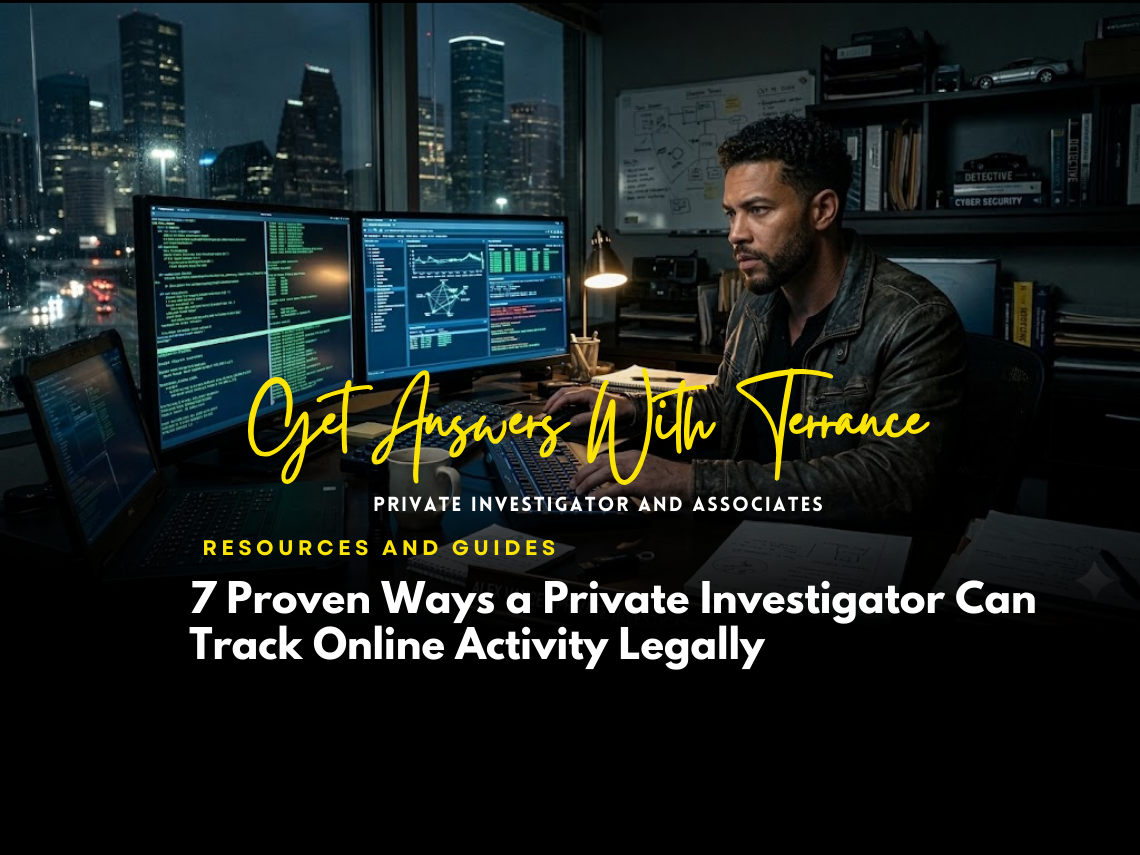
Can a private investigator track online activity? If you have ever asked that question about a spouse, a business partner, an employee, or a subject in a legal matter, you are not alone. It is one of the most searched questions in the private investigation industry today, and the answer is a clear yes.
A licensed private investigator can track online activity legally, professionally, and in ways that produce real, court-admissible evidence. But the how matters just as much as the yes. The tools, methods, and legal boundaries that define a legitimate digital investigation are what separate a licensed PI from someone who could land themselves, or their client, in serious legal trouble.
At Terrance Private Investigator & Associates, we have helped clients across Houston and Texas get the truth about what is happening online. This post breaks down exactly how a private investigator tracks online activity, what warning signs signal that you may need one, and what to consider before hiring a digital surveillance professional.
How a Private Investigator Tracks Online Activity Legally
When a private investigator tracks online activity, they rely on a discipline called Open-Source Intelligence, commonly known as OSINT. OSINT is the legal collection and analysis of publicly available information from digital sources. It includes everything from social media platforms and public databases to business filings, forum posts, and digital footprints left across the web.
OSINT is not just Googling someone. It is a structured, methodical process that involves verified data sources, cross-referenced findings, and a strict chain of custody for every piece of evidence gathered.
The 7 Core Methods a Licensed PI Uses to Track Online Activity
Here are the seven core methods a licensed private investigator uses to track online activity legally, each producing documentation built to hold up in court.
- Social Media Intelligence (OSINT searches): deep platform searches across Facebook, Instagram, X, TikTok, LinkedIn, YouTube, and more. Even on accounts that appear private, information shared by a subject’s network is often publicly visible and legally accessible.
- Cross-Platform Username and Alias Tracing: many people reuse the same username or email handle across dozens of platforms, and a PI can trace those identities across forums, dating apps, gaming communities, review sites, and marketplace listings.
- Public Records and Legal Database Research: licensed investigators access legal databases that pull from voter registrations, property records, court filings, business licenses, and known associates to build a court-ready digital profile.
- Digital Footprint Analysis: every membership signup, survey, online purchase, and public post leaves a traceable trail across search engines, metasearch platforms, and deep web indexes.
- Certified Device Forensics (with consent): when a client has legal authority over a device, such as employer-owned equipment or a shared household computer, a PI can recover deleted files, browser histories, and email records while preserving full chain-of-custody integrity.
- Social Media Forensic Software: specialized tools surface deleted posts, archived stories, and behavioral patterns invisible to a standard browser search, all captured within lawful boundaries.
- Court-Ready Digital Evidence Documentation: every finding is compiled into a professionally formatted report with timestamps, metadata, source records, and chain-of-custody documentation built to withstand legal scrutiny.
Warning Signs You May Need a Digital Investigation
Knowing when to hire a private investigator to track online activity is just as important as understanding how it is done. These are the warning signs that something may be happening online that warrants a professional investigation.
In personal relationships: your partner has become secretive about their phone or laptop, created new accounts you were not told about, uses apps you do not recognize, or their online behavior has significantly changed. You may have noticed unfamiliar check-ins, suspicious tagged photos, or irregular hours they cannot fully account for.
In business situations: a business partner is operating what appears to be a competing entity online. An employee is soliciting your clients through personal accounts, leaking proprietary information in forums or LinkedIn groups, or using company devices for unauthorized purposes.
In legal matters: a subject in a custody case is posting content online that contradicts what they have stated in court, or someone involved in an insurance or personal injury claim is documented living a lifestyle inconsistent with their legal claims.
In fraud scenarios: a person or business you are involved with has inconsistencies between what they claim publicly and what their digital presence actually shows, such as different business names, duplicate identities, or mismatched professional histories.
A Real-World Case: Tracking a Competing Business Online
A Houston-area business owner came to Terrance PI with a difficult situation. Their long-time business partner had been acting strangely, taking unexplained meetings, protecting their devices, and gradually distancing themselves from shared business decisions. The client suspected the partner was building a competing company while still employed and collecting a salary.
Our investigators began tracking online activity using OSINT tools and public business database searches. Within 72 hours, we had located a newly registered LLC under the partner’s name, active social media business pages soliciting the client’s own customer base, and a documented pattern of public online communication used to build the competing venture, all of it publicly available and legally gathered.
The complete digital evidence report, including timestamps, source documentation, and metadata, was delivered to the client’s attorney and used directly in legal proceedings. The case resolved in our client’s favor. Not one piece of evidence was challenged, because every method we used to track online activity was fully compliant with Texas law.
When a private investigator tracks online activity the right way, the evidence does not just inform, it wins.
Terrance Private Investigator & Associates
What a PI Can and Cannot Legally Do Online
From a licensed investigator’s standpoint, digital surveillance is one of the most powerful and most misunderstood areas of private investigation today. Clients often come to us after attempting to find information themselves, only to discover they have either crossed a legal line or collected evidence that will not hold up in court.
What a private investigator can legally do when tracking online activity: monitor public social media profiles and posts, trace public usernames and aliases, access legal databases for public records, analyze digital footprints from publicly accessible platforms, and perform device forensics with proper consent and legal authority.
What a private investigator cannot legally do: access private messages or accounts without authorization, install monitoring software without consent, intercept electronic communications, or hack into any private digital system. These actions violate the Electronic Communications Privacy Act (ECPA) and Texas privacy statutes, and any evidence gathered that way would be inadmissible and potentially criminal.
What to Consider Before Hiring a PI to Track Online Activity
Before hiring a private investigator to track online activity, work through the following considerations so your investigation is targeted, lawful, and cost-effective.
- Define your goal clearly. Are you looking for evidence of infidelity, business misconduct, fraud, or something else? The clearer your objective, the more targeted and cost-effective the investigation will be.
- Verify licensing. In Texas, private investigators must be licensed through the Texas Department of Public Safety Private Security Bureau, so always confirm your PI holds a valid Texas license.
- Understand what is admissible. If you intend to use digital evidence in a legal proceeding, make sure your PI documents findings in a court-admissible format with proper metadata, timestamps, and chain-of-custody records.
- Think about timing. Digital evidence can disappear quickly as posts get deleted, accounts get deactivated, and profiles go private, so the sooner you engage a PI, the better your chances of preserving it.
- Confidentiality matters. A reputable firm will never contact the subject of your investigation or disclose your identity, and operates with full confidentiality protocols in place.
- Consider cost versus risk. Attempting a digital investigation yourself can result in inadmissible evidence, legal liability, or tipping off the subject, while a professional investigation is an investment in getting it done right once.
Final Thoughts on Tracking Online Activity the Right Way
The internet leaves a trail. Every post, profile, username, business filing, and digital interaction is a breadcrumb, and a skilled private investigator knows exactly how to follow them legally, efficiently, and in ways that hold up when it matters most.
Can a private investigator track online activity? Yes. But more importantly, the right private investigator tracks online activity in a way that protects you, your case, your confidentiality, and your legal standing, every step of the way.
At Terrance Private Investigator & Associates, we combine licensed expertise, proven OSINT methods, and a client-first approach to deliver digital investigations that get results. Whether you are in Houston or anywhere across Texas, we are ready to help you find the truth the right way, before the evidence disappears.
Frequently Asked Questions
Can a private investigator legally track someone's online activity?
A licensed investigator can lawfully review publicly available information — public social media, public records, and open-source data. We do not hack accounts, guess passwords, or access private messages, because evidence gathered illegally is worthless in court and exposes you to liability.
What online information can actually be used as evidence?
Public posts, profiles, timestamps, location tags, and publicly visible connections can all be documented and preserved in a court-ready format. The key is capturing it properly, with dates and context, before it disappears.
Can you recover deleted messages or posts?
We do not break into private accounts. However, content that was public, cached, or shared with third parties can sometimes still be documented. We will tell you honestly what is and is not obtainable in your situation.
Is online investigation enough on its own?
Often it is one piece of a larger picture. Digital findings are strongest when combined with surveillance, background research, and other lawful methods that corroborate what the online trail suggests.
Contact Us
If something in your own situation feels unresolved, you do not have to sort through it alone. Terrance Private Investigator & Associates helps clients across Texas turn uncertainty into clear, documented facts — discreetly, professionally, and with your best interests guiding every step.
Reach out today for a confidential consultation. Tell us what you are dealing with, and we will help you understand your options and the best way forward. We will take it from there.
Email: getanswers@piterrance.com Website: piterrance.com Call : (833) 495 0003